Air vs sea freight from China to the UK: which one fits the shipment?
Fly it in a week or sail it in two months? The answer rarely comes down to speed alone. This guide shows how each mode is really charged, where the cost gap comes from, and the shipment sizes where air, sea and courier each make sense.
Most freight decisions start with a deadline. A new product range is due on the shelves for spring, a best-seller is about to run out, or a supplier has finally confirmed the ready date three weeks later than promised. At that moment air freight looks like the obvious fix: five to ten working days instead of six to eight weeks. Then the quote arrives, and the freight bill is worth more than a large slice of the stock it is carrying.
The gap is not a pricing trick. Air and sea freight measure a shipment in completely different ways, and once that difference is clear, the choice becomes a piece of arithmetic rather than a guess.
Quick version: sea freight wins for almost any stock order above 1 to 2 CBM that can wait six to eight weeks. Air freight earns its cost for urgent, high-value or dense goods of roughly 150 to 500 kg. Below that, express courier is usually simpler and cheaper than either. When only part of an order is urgent, fly that part and ship the rest by sea.
How each mode charges for the same cartons
Sea freight is charged on volume. LCL (shared container) is priced per cubic metre, or per tonne if the goods are heavier than one tonne per CBM, whichever figure is greater. A full container (FCL) is a flat rate per 20ft or 40ft box, regardless of how full it is. The LCL vs FCL guide covers where one becomes cheaper than the other.
Air freight is charged per kilogram of chargeable weight: either the real weight on the scale or the volumetric weight, whichever is higher. Air carriers count every cubic metre as 167 kg. Express couriers are stricter, at about 200 kg per CBM. That single rule explains most of the shock in an air freight quote. A shipment of light, bulky goods pays to fly the space it takes up, not just its weight.
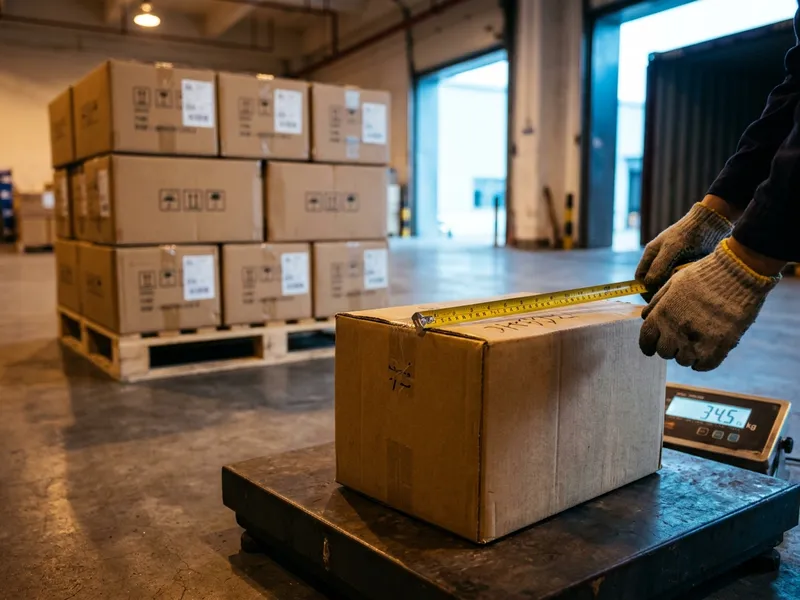
Carton dimensions and gross weight decide the bill: sea freight charges on volume, air freight on whichever is higher of real or volumetric weight.
Sea freight (LCL / FCL)
Air freight
Express courier
Charged on
CBM (LCL) or per container (FCL)
Chargeable kg (1 CBM = 167 kg)
Chargeable kg (1 CBM = 200 kg)
Typical door-to-door time
5–7 weeks FCL, 6–8 weeks LCL
5–10 working days
3–7 working days
Usually suits
1 CBM and above, regular stock
~150–500 kg, urgent or high value
Samples, up to ~100–150 kg
Restrictions
Fewest, with declared dangerous goods allowed
Tight on batteries, liquids, magnets, powders
Tightest, with many battery products refused
Carbon per kg moved
Lowest
Highest
High
A worked example: 40 cartons, two ways
Take an order of 40 cartons, each 60 × 40 × 40 cm and 12 kg. That is 3.84 CBM and 480 kg on the scale, enough to fill two UK pallets.
By sea (LCL): charged on 3.84 CBM, because the goods weigh less than a tonne per cubic metre.
By air: the volumetric weight is 3.84 × 167 = about 640 kg. The cartons are billed as 640 kg, not 480 kg.
Using published indicative rates checked on 2 November 2026, the gap looks like this. Freightos lists air freight from Shanghai to London from $925 per 100 kg. SINO Shipping gives October 2026 LCL ocean rates to the UK of about $55 per CBM. On those figures, the air leg comes to roughly $5,900 and the ocean leg to roughly $210. That makes air about 28 times the sea leg before any other charges.
Air is billed on 640 kg of volumetric weight; sea is billed on 3.84 CBM. Even after UK destination fees, which can run to a few hundred pounds on a small LCL shipment, sea stays far cheaper.
Those are freight-leg figures, not door-to-door prices. LCL carries destination charges at the UK end for deconsolidation, handling and delivery, and on a small shipment these can rival the ocean freight itself. Air adds airport handling and UK delivery too. Rates also move every month. The point of the example is the ratio, not the exact figure: for ordinary stock orders, the gap is too wide for destination fees to close.
The hidden cost on the air side: duty and VAT
UK customs value includes the cost of getting goods to the UK border. A larger freight bill therefore raises the value on which import duty and import VAT are calculated, so air freight costs more twice: once on the invoice, and again at clearance. Import VAT may be recoverable for a VAT-registered business, but duty is not. The duty and VAT guide shows how the calculation is built, and the landed cost guide shows how freight feeds into the true unit price.
When air freight is worth paying for
The cost of running out is higher than the freight bill. If six weeks without stock loses more margin than the extra freight, flying is the cheaper decision, even though it looks expensive.
Dense, high-value goods. Electronics accessories, components or cosmetics with a high value per kilogram pay mostly for real weight, so the volumetric penalty is small and the freight is a small share of the stock value.
A fixed launch date. A trade show, retail reset or marketing campaign that cannot move.
The middle weight band. Freightos notes that standard air freight is usually the cheapest option for shipments between about 150 kg and 500 kg, too heavy for courier pricing and too small to justify the fixed costs of sea freight.
When sea freight is the right call
Regular stock orders above 1 to 2 CBM with a reorder plan that allows for six to eight weeks.
Light, bulky products such as homeware, furniture, packaging or soft goods, where volumetric weight makes air prohibitive.
Battery products and other restricted goods. Air rules for lithium batteries are tight and many couriers refuse standalone batteries outright. The lithium battery shipping guide explains what changes by mode.
Margin-sensitive products where a few pounds of freight per unit decides whether the line is worth stocking at all.
The split shipment: when only part of an order is urgent, there is no need to fly all of it. A common approach is to fly a small batch to cover the next few weeks of sales, and send the bulk of the same order by sea. The air premium is paid only on the units that genuinely need to arrive early.
Plan the calendar, and air freight becomes the exception
Most urgent air freight is a planning problem that surfaces late. The supplier's real ready date slips, the reorder point was set too low, or Chinese New Year closes factories just as stock runs out. Building six to eight weeks of sea transit into the reorder point, plus a buffer for production delays, removes most of the need to fly. For spring 2027 stock, the timing matters now: the Chinese New Year 2027 guide sets out the order deadlines and the last realistic sea departures before the holiday.
Where Bridgeway fits
Bridgeway's freight work centres on sea: LCL, full containers and palletised shipments from the main Chinese export regions to UK doors, joined up with customs clearance and final UK delivery. When an order genuinely needs to fly, the honest advice is to book that portion with a specialist air forwarder or an express courier account, and to keep the rest of the stock on the water. The China to UK shipping service covers how sea routes are planned and priced to the door.
Written by ChrisChris writes the Bridgeway Imports guides in Manchester, working from the supplier quotes, shipment files and customs paperwork the team handles for UK importers.
Common questions
Quick answers on air vs sea freight.
How much more expensive is air freight than sea freight from China to the UK?
On the freight leg alone, air usually costs many times more than sea for the same goods, because air charges per kilogram of chargeable weight while sea charges per cubic metre. In a worked example of 3.84 CBM and 480 kg, the indicative air leg was roughly 28 times the ocean leg. Fixed sea-freight fees narrow the gap on very small shipments, so compare door-to-door totals, not headline rates.
Which is better, air freight or sea freight?
Neither is better in general. Sea freight suits most stock orders above about 1 to 2 CBM that can wait six to eight weeks. Air freight suits urgent, high-value or dense goods of roughly 150 to 500 kg. Below that, express courier is usually simpler.
How long does sea freight from China to the UK take?
The ocean crossing to Felixstowe or Southampton is usually around four to five weeks. Door to door, including consolidation, customs and UK delivery, plan for five to seven weeks for a full container and six to eight weeks for LCL. Chinese New Year and peak season add time.
When is express courier better than air freight?
For samples and shipments below roughly 100 to 150 kg. Courier rates include collection, clearance handling and delivery, while air freight adds airport, handling and UK delivery charges that make small loads expensive per kilogram.
Price the sea route
Want to know what the same order costs by sea?
Send the supplier quote, carton details, ready date and UK destination. Bridgeway will reply with a sea freight route and a door-to-door cost view.