Choose by use, not by listing name
The quick answer
A compliant pedal-assist EAPC e-bike is usually the simplest fit: cycle-lane access, no registration and useful assistance on hills.
A legal EAPC or cargo e-bike suits dense urban drops. A registered electric moped can suit longer shifts, heavier loads and wider delivery areas.
A standing e-scooter can work inside a privately controlled campus with the landowner's permission and a proper safety policy.
Why e-bikes fit many UK commutes
For a commute that mixes residential streets, cycle lanes and city-centre traffic, a properly specified EAPC e-bike removes much of the effort from hills and stop-start riding without becoming a motor vehicle. It still needs usable pedals, a motor with no more than 250W continuous rated power, and assistance that cuts out at 15.5mph.
That makes it a practical option for employees who want to arrive with less fatigue, avoid parking costs and carry a laptop or small amount of work equipment. Buyers should prioritise dependable brakes, lights, weather protection, a removable battery and a realistic range under rider-and-cargo load — not just the largest advertised wattage.
Does an e-bike make sense for food delivery?
Often, yes — especially where deliveries are short, parking is difficult and riders make repeated stops. Pedal-assist cargo bikes can carry insulated boxes or panniers without the rider repeatedly starting a heavier petrol-style vehicle. Charging and battery swapping can also be planned around shifts.
The business case changes with distance, terrain, payload and shift length. A restaurant serving a compact radius may need a different bike from a multi-site operator covering suburban routes. A buyer should model:
- loaded range in cold and wet conditions, not only a factory laboratory figure;
- battery charging, secure indoor storage and fire-safe handling;
- braking performance, tyres, lights and maintenance intervals under commercial use;
- rider fit, cargo stability and whether the frame is rated for the expected payload;
- spare batteries, chargers, replacement parts and warranty response time.
Government battery guidance notes that counterfeit, damaged or poorly modified e-cycles and incorrect chargers can increase fire risk. Commercial operators should buy traceable batteries and compatible chargers, keep inspection records and plan safe charging before building a fleet.
Where a standing e-scooter actually fits
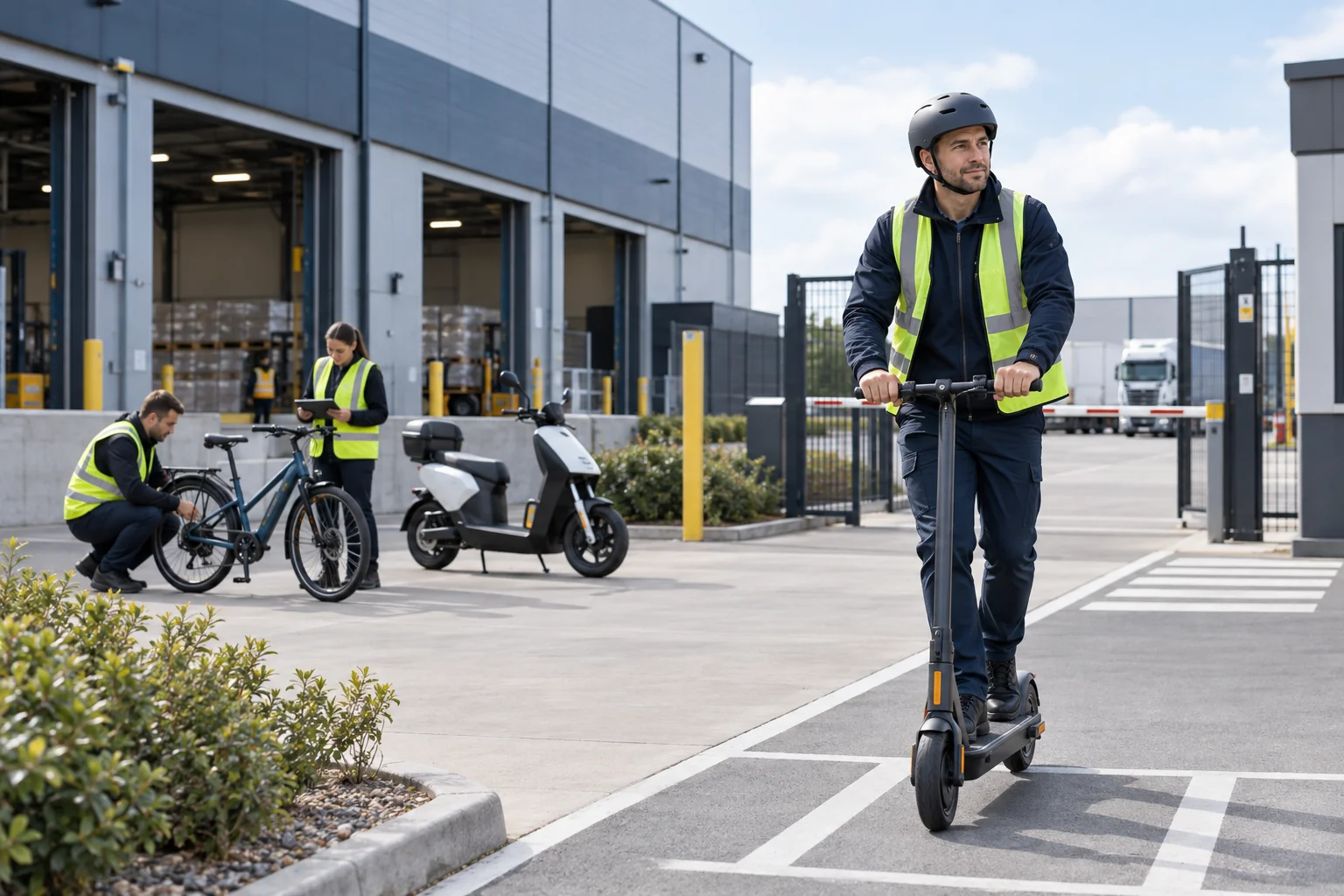
A privately owned standing e-scooter is not a normal road-delivery solution in the UK. It cannot legally be ridden on public roads, pavements or parks. Its realistic use case is private land with the landowner's permission: a warehouse campus, resort, events site, industrial estate or other controlled environment.
Even on private land, the operator needs a route plan, speed controls, charging rules, rider training, protective equipment and an assessment of pedestrians and vehicle movements. For public-road journeys, an approved rental scooter within an official trial is a different category and operates under scheme rules.
When an electric moped is the better commercial tool
An electric moped may suit longer delivery zones, steeper routes, heavier schedules or riders who need consistent motor-powered travel without pedalling. But the convenience comes with motor-vehicle obligations: the correct approval and registration route, insurance, an appropriate licence, tax status where applicable, number plate, compliant helmet and roadworthy equipment.
For a fleet buyer, the supplier's use of words such as “EEC certified” is not enough on its own. The approval documentation, vehicle identification, exact variant and certificate scope need checking before the deposit. Batteries, chargers, replacement panels, brake parts and diagnostic support also matter over the working life of the fleet.
A buying checklist before you request prices
- State the journey: public road, cycle lane, private land or mixed use.
- State the load: rider, cargo, box or panniers and expected daily mileage.
- Confirm the category: EAPC, private-land scooter or motor vehicle.
- Request evidence: motor rating, speed cut-off, approval documents, battery specification and charger details.
- Price the full route: samples, inspection, freight, dangerous-goods handling, duty, VAT, registration preparation and final delivery.
- Plan after-sales support: spares, warranty ownership and safe battery replacement.
How Bridgeway Imports can help
Bridgeway can compare supplier models against the intended UK use, question unclear specifications, check certification claims, organise samples or inspections, and calculate freight, customs and delivery costs before an order is released. We do not replace DVLA, DVSA, product-safety or legal advice; the aim is to identify the right questions before money moves.
Send the real use case
Planning a delivery fleet, commuter range or private-site trial?
Send the route, payload, target quantity and supplier link. We will help classify the product and build a sourcing plan.